
The ultimate guide to turbo adhesives

An in-depth analysis of speed, strength and material compatibility

Why turbo adhesives are so popular today

The adhesives market is changing rapidly. Professional users no longer expect just strong bonds; they expect speed, safety and convenience on site. Three key developments are driving the current trend towards turbo hybrid polymers:

  • Higher productivity demands
    Faster curing means faster progress, less waiting time and less need for mechanical support.

  • Wide variety of materials
    Modern construction and renovation combine wood, metals, plastics, natural stone, rubber, composites and insulation boards in a single project. An adhesive must therefore be versatile.

  • Safety and regulations
    Traditional adhesive technologies are increasingly falling out of favour due to isocyanates, solvents and mandatory safety training. Hybrid polymer adhesives offer the same or better performance without these drawbacks.

Turbo-hybrid polymer adhesives meet all these expectations, but… not every turbo adhesive is the same. A thorough understanding of the technology and the selection criteria is essential for anyone wishing to make a professional choice.

Some key terms

To make the right technical choice, we’ll first break down some key terms in the world of hybrid polymer adhesives.

               Already an expert? Go straight to the selection guide.

Porous vs. non-porous

Hybrid polymer adhesives cure under the influence of humidity. The way in which the bonded material itself reacts to humidity plays a crucial role.

  • Porous materials (wood, concrete, etc.): These materials have an ‘open’ structure, allowing air and moisture to pass through. As a result, the adhesive cures much faster.

  • Non-porous materials (metal, glass, PVC, etc.): These do not absorb moisture and do not allow air to pass through. The adhesive is therefore entirely dependent on the moisture that penetrates via the often minuscule edges.
Initial adhesion (tack) vs. functional strength (hand-tight) vs. final strength

It is essential to distinguish between three phases of adhesion to prevent structural failure:

  • Initial adhesion (Tack): This figure indicates how much weight the adhesive can bear from the very first second. This is usually stated in kg/m².

  • Functional strength (hand-tight): The point at which the bond is strong enough to remove clamps or supports.

  • Final strength: The maximum load that the adhesive can bear after full curing, usually expressed in kg/10cm². This often takes weeks or even months.

The impact of temperature

  • Skin formation: This is the period during which the adhesive is still ‘wet’ enough to bond. If you work outside this period, bonding with the second material will no longer take place. Higher temperatures accelerate this process and vice versa.

  • Working temperature: The temperature range within which the product can generally be used without any problems.

Selection guide: the perfect turbo adhesive

Navigating the turbo segment can be difficult. All sorts of terms and figures are thrown around. Below, we list the most important criteria for you.

Functional strength (hand-tight)

Functional strength is the point at which a bonded assembly has cured sufficiently to support itself, even under (light) manipulation. For a turbo adhesive, this is the most important parameter.

  • Are you bonding porous materials (wood, concrete, etc.)? Ideally, the adhesive should be hand-tight in less than 20 minutes.

  • Are you bonding non-porous materials (metal, glass, plastics, etc.)? Curing takes longer, usually within 2 to 3 hours.

Initial tack

Are you bonding materials in a suspended or vertical position? Then high initial tack is required to prevent loosening or slipping. High-tack turbo adhesives are rare, as speed and tack are often difficult to combine.

Typical market breakdown:

  • Turbo: extremely fast, but limited tack

  • High Tack: slower curing, but extremely high tack

  • Turbo Tack: the rare combination of both

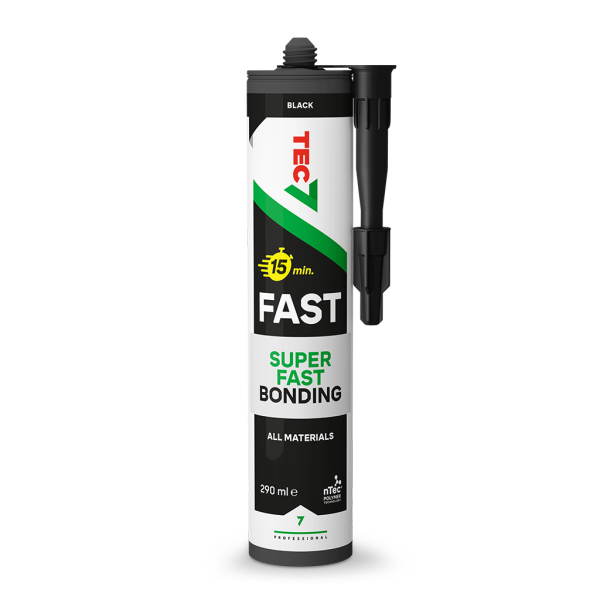
For example: Tec7 Fast belongs to the latter category; a turbo adhesive with a high tack of no less than 250 kg/m².

Are you bonding very heavy materials? Then a pure high-tack adhesive, such as X-Tack, is the better option.

Working temperature

Curing times slow down at low temperatures and speed up at high ones. So be sure to pay attention to the application temperature.

Is it over 30°C? Then working with a turbo adhesive is generally not recommended. Skin formation occurs so quickly that there is little to no adhesion.

Are you working in freezing conditions? Many turbo adhesives only work from +5°C. High-quality turbo adhesives, such as Tec7 Fast, work from as low as -10°C.

Speed across a wide range of materials

Many turbo adhesives achieve their speed on just one or two materials. With other materials or substrates, the curing times are immediately much longer. Look for a turbo adhesive that is as versatile as possible without compromising on performance.

Easy to use

High-tack adhesives, as well as many ‘turbo tack’ adhesives (turbo adhesives with high initial tack), are very stiff. This makes them difficult to apply and also means they cannot be pressed down completely flat.

Tec7 Fast stands out in this respect, combining speed and high initial tack with ease of application.

Extra: KOMO quality mark (Benelux)

Although KOMO is not a legal requirement, it is increasingly being included as a requirement in specifications or tenders in the Benelux. This independent quality label guarantees that products, processes and services meet objective technical and quality-oriented requirements.

For tradespeople, this means less risk of failure costs, fewer disputes on site and a smoother documentation and handover process.

So, do you want 100% independently verified certainty? Then choose a turbo adhesive with a KOMO quality mark.

Tec7 Fast “top of the class”

Tec7 is known as one of the most powerful and versatile hybrid polymer adhesives on the market. With Tec7 Fast, they are now setting a new benchmark within the turbo segment:

  • Functional strength in just 15 minutes on porous materials

  • Very high initial adhesion for a turbo adhesive: 250 kg/m²

  • KOMO certified

  • Performs on virtually all materials, even difficult ones such as PC, EPDM, plexiglass, blue stone, etc.

  • Easy to apply

  • Works from –10°C

  • Free from toxic substances (solvents, phthalates, isocyanates, etc.)

  • No staining on natural stone

  • Suitable for horizontal, vertical and suspended installation

Frequently asked questions about turbo adhesives

What is the difference between superglue and turbo adhesive?

Although both are fast-setting, they work differently. Superglues (cyanoacrylates) are thin and intended for very small, perfectly fitting surfaces. Turbo adhesives based on hybrid polymers have a thicker consistency, fill gaps, remain elastic and are suitable for larger (construction) materials such as panels, skirting boards and profiles.

Why do turbo adhesives cure more slowly on metals or plastics?

Hybrid polymer adhesives cure through contact with atmospheric moisture. With porous materials such as wood or concrete, they contain moisture and air can reach the adhesive through the material. With non-porous materials (metal, glass, PVC), moisture can only penetrate via the edges, meaning the process takes longer to reach the core.

Does freezing cold affect the performance of a turbo adhesive?

Yes, for most chemical curing processes, the colder it is, the slower the process. Many turbo adhesives even stop curing completely below +5°C. However, there are specialised variants, such as Tec7 Fast, which can be used down to -10°C, but bear in mind that the ‘turbo speed’ in freezing conditions is always lower than at room temperature.

Is a turbo adhesive stronger than a 'standard' adhesive?

Generally, no. A turbo adhesive is designed to reach its functional strength (hand-tight) more quickly. Whilst the final strength after full curing is still high, it is often lower than that of standard hybrid polymers. The main advantage therefore lies in the time saved, not necessarily in a higher maximum load.

Can I use a turbo adhesive for structural applications?

Turbo adhesives are ideal for assembly work (skirting boards, wall panels, staircase renovation), but for structures subject to constant, heavy mechanical stress or designed to meet specific building regulations, the technical data sheet must always be consulted. Also look out for labels such as the KOMO quality mark for objective quality assurance in construction.

More on Tec7 Fast

Find a dealer

You have a question?

You can always call or email us.